 Stratux
 antennas
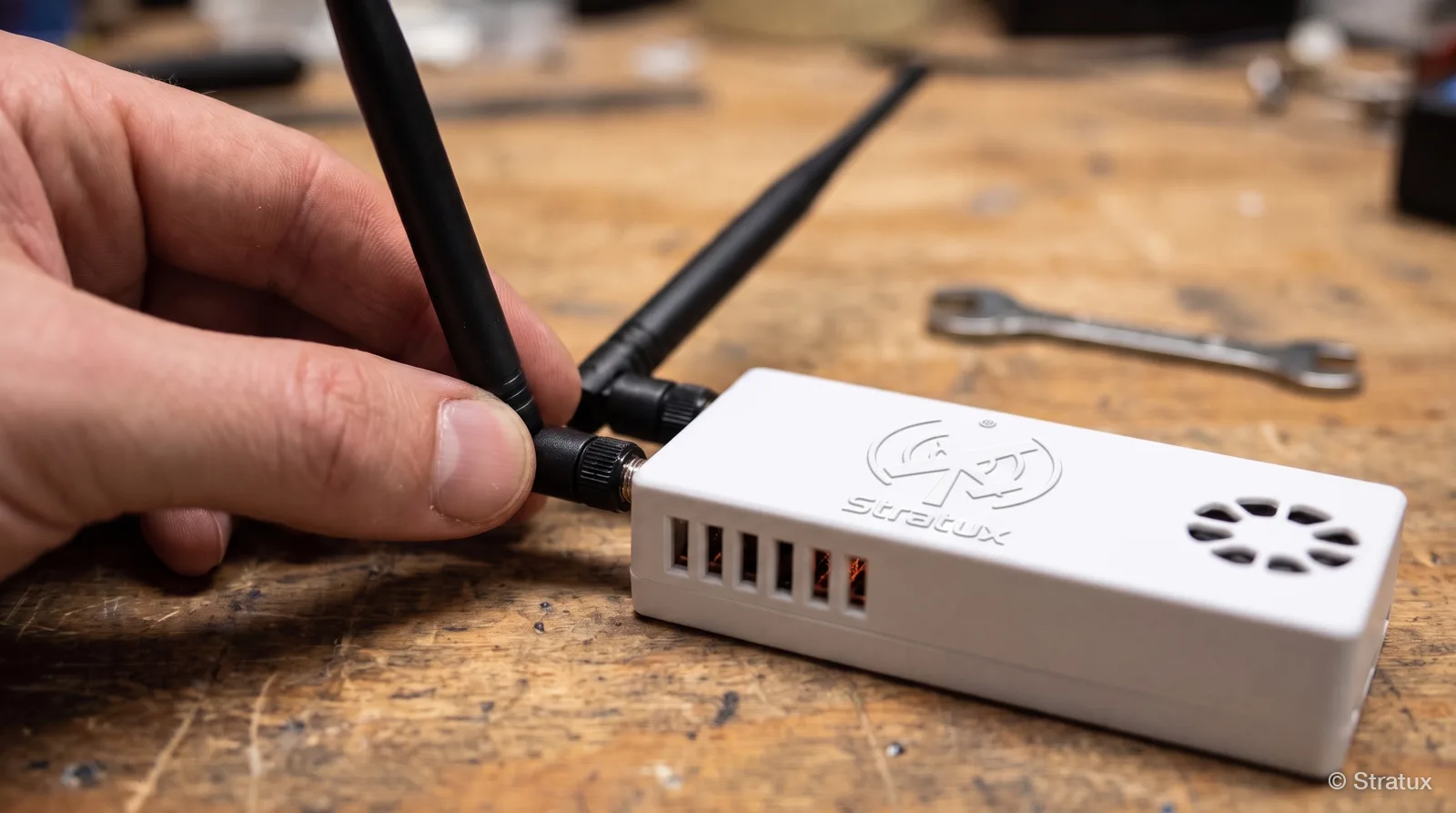
Put the 978 MHz antenna on the 978 port and the 1090 MHz antenna on the 1090 port. Hand-tighten both. Don't use pliers, since they can break the small internal cables behind the ports. A broken 978 cable is a common and cheap fix.
Which port is which
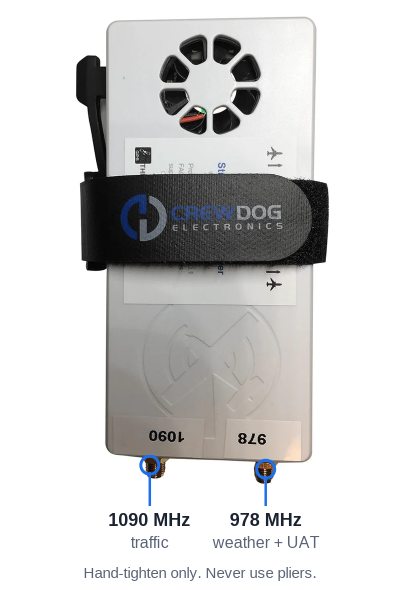
The case labels the two ports. With the fan at the top, you'll find 1090 on the left and 978 on the right.
Which antenna is which
| Antenna | Receives | Notes |
|---|---|---|
| 978 MHz | UAT: FIS-B weather and UAT traffic | FIS-B weather needs a 978 ground station: the US and Canada have them, and a few countries are adding them. UAT traffic from nearby aircraft comes direct. See Canada and international |
| 1090 MHz | 1090ES traffic | Works worldwide, on the ground and in the air |
| 868 MHz | FLARM / OGN (Europe builds) | Needs the extra 868 MHz radio. See Stratux in Europe |
Compact (3 dBi) and large (5 dBi) antennas are both available on the parts page. If your cockpit gets poor reception, a larger antenna can help.
What makes a good 1090 MHz antenna
ADS-B signals are vertically polarised, so a 1090 MHz antenna works best standing straight up. That's why the placement advice below says vertical.
Each antenna is cut for its band. At 1090 MHz the wavelength is 275 mm, so a quarter-wave element is about 69 mm. At 978 MHz the wavelength is about 307 mm and a quarter wave is about 77 mm. Put each antenna on its own port and don't swap them.
What about a 1090 MHz collinear?
A collinear stacks several elements in a vertical line, fed so they all radiate in phase. In theory, doubling the elements adds about 3 dB of gain. The one in our source is a home-built ground antenna, and it says the higher you mount it, the better it works.
We haven't tested a collinear on a Stratux in a cockpit, so we won't tell you it beats the included 3 dBi or 5 dBi antennas there.
Source for the numbers in this section: Collinear Antennas For Aircraft ADS-B Signals, Silicon Chip, September 2013, and L. B. Cebik's notes on coaxial collinears for the in-phase point. The 978 MHz figures use the same formula (wavelength = speed of light ÷ frequency).
Hand-tighten only
Finger-tight is all it needs. Never use pliers on the antennas. Don't over-tighten, or you'll snap the small internal cables (pigtails) that connect the antenna ports to the radios.
Loose antenna port
If a port spins or wobbles:
- Power off and open the case.
- Hold the nut on the inside of the case.
- Tighten the nut on the outside with the included wrench.
- Make sure the internal cable isn't twisted before you close the case.
Broken internal cable
The 978 MHz UAT radio connects through a small u.FL cable that can break if the antenna is forced. It's a cheap, common repair to replace it with a u.FL-to-SMA pigtail.
Placement
Keep the antennas vertical and away from large metal surfaces where you can. Give Stratux a view of the sky for GPS. On the ground, weather is often out of range no matter how good your antennas are.
Frequently asked questions
Can I tighten the antennas with pliers?
No. Finger-tight is all it needs. Pliers can break the small internal cables (pigtails) that connect the antenna ports to the radios.
Which antenna goes on which port?
The 978 MHz antenna goes on the 978 port and the 1090 MHz antenna on the 1090 port. The labels are printed on the case, and the 1090 port is on the left when the fan is at the top.
Where should I mount the antennas?
Keep them vertical and away from large metal surfaces where you can. Give Stratux a view of the sky for GPS.
Is a 1090 MHz collinear antenna better for Stratux?
A collinear adds gain by stacking elements that radiate in phase. We haven't tested one on a Stratux in a cockpit, so we can't say it beats the included 3 dBi or 5 dBi antennas there.
Next step: if the UAT count stays at zero on the status page, check the pigtail and read choosing and identifying Stratux radios.